World · Field notes

Italy

Three details to notice, with the sources behind each story.

Explore Italy in Atlas →

geography

Canals between the islands

Venice, in northeastern Italy, grew across 118 small islands in a sheltered area of coastal water. The channels between them became canals as the settlements joined into a city, which helps explain why boats are so central to getting around Venice.

Source: UNESCO: Venice and its Lagoon · Accessed 2026-10-06
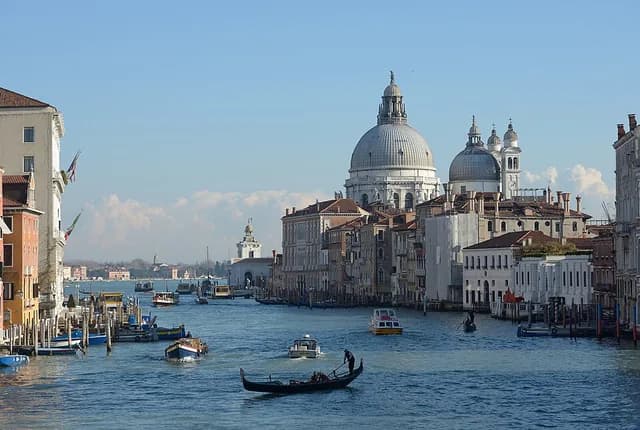
Buildings and boats along the Grand Canal in Venice.
The Grand Canal in Venice, a city spread across lagoon islands.
This Photo was taken by Wolfgang Moroder. Feel free to use my photos, but please mention me as the author and send me a message. This image is not in the public domain. Please respect the copyright protection. It may only be used according to the rules mentioned here. This specifically excludes use in social media, if applicable terms of the licenses listed here not appropriate. Please do not upload an updated image here without consultation with the Author. The author would like to make corrections only at his own source. This ensures that the changes are preserved.Please if you think that any changes should be required, please inform the author.Otherwise you can upload a new image with a new name. Please use one of the templates derivative or extract. / Wikimedia Commons / CC BY-SA 3.0. Resized and converted to WebP; no cropping. · CC BY-SA 3.0
culture

Houses built by fitting stones together

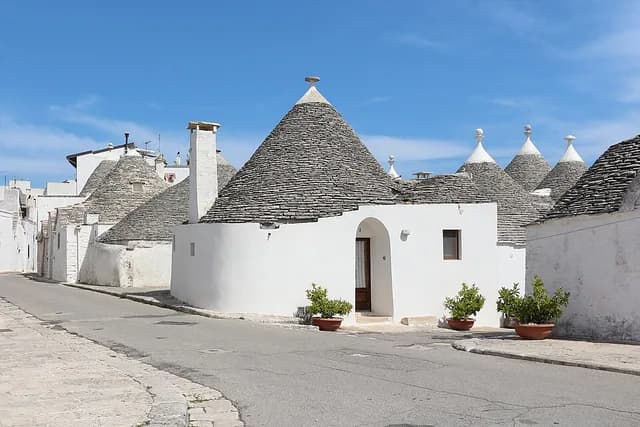
In Alberobello, a town in southern Italy, traditional homes called trulli have pointed stone roofs. Builders fitted limestone pieces together without mortar, the paste normally used to hold bricks and stones together. The roof is built from stone slabs too.

Source: UNESCO: The Trulli of Alberobello · Accessed 2026-10-06

Whitewashed trulli houses with conical stone roofs in Alberobello.
Traditional trulli in Alberobello, Puglia.
Bernard Gagnon / Wikimedia Commons / CC0. Resized and converted to WebP; no cropping. · CC0

history

How ash preserved human outlines

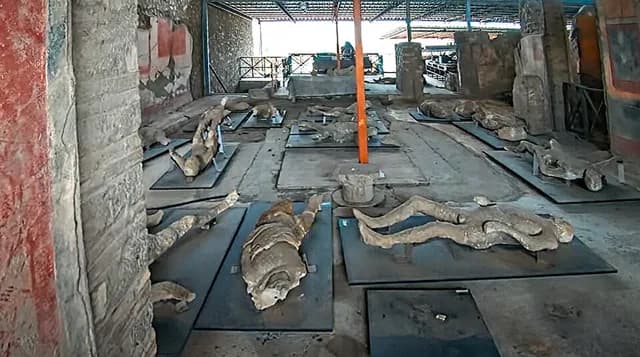
When Mount Vesuvius erupted in AD 79, it buried the Roman town of Pompeii in southern Italy. Some victims left body-shaped spaces in the hardened ash; archaeologists later filled those spaces with plaster to recover their outlines, creating the casts seen today.

Source: Archaeological Park of Pompeii: The Casts · Accessed 2026-10-06

Plaster casts displayed at the archaeological site of Pompeii.
Casts at Pompeii, made from cavities in the volcanic deposits.
Isaac Harjo of Prowalk Tours / Wikimedia Commons / CC BY-SA 4.0. Resized and converted to WebP; no cropping. · CC BY-SA 4.0